Process Equipment
This is a list of the primary theories in physics, major subtopics, and concepts
Women Graduates are trained with basics in Industry application from basic science Mathematics, Physics, Chemistry
Training in application Software by Industry Professional, to train others with preparation as TRAINER to empower.
Empowering areas are ACADEMIC SERVICE-ENTREPRENEURSHIP-DESIGN SERVICE-INDUSTRIES-SOCIAL ENGINEERING
Overview
UNIT I
Four Exmples from Text Book will be given trainingOn software listed For the program Four problem will be given for self training with software to Trainee
Overview
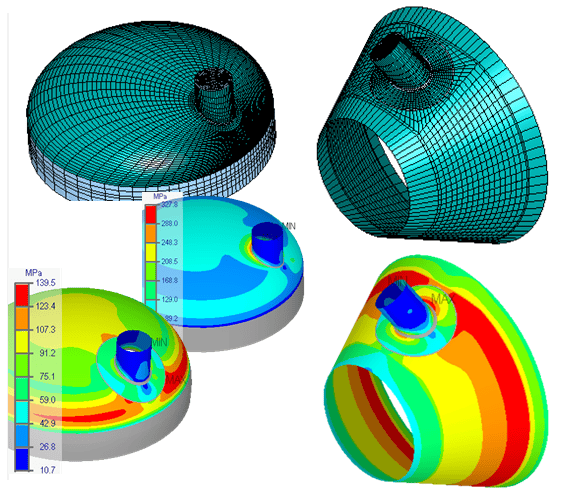
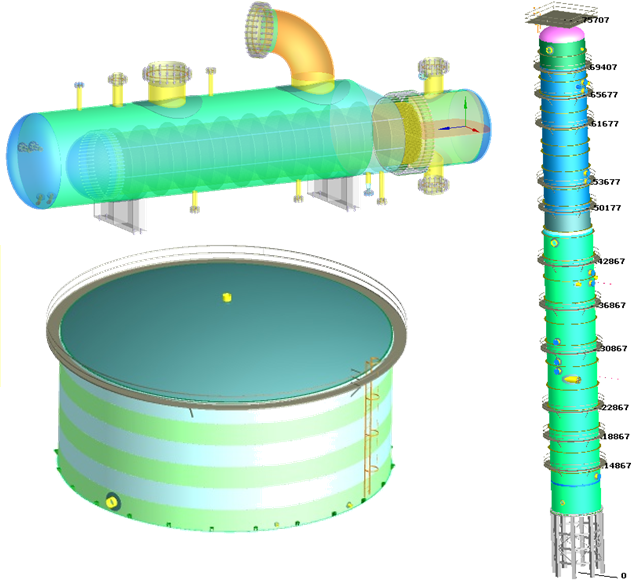
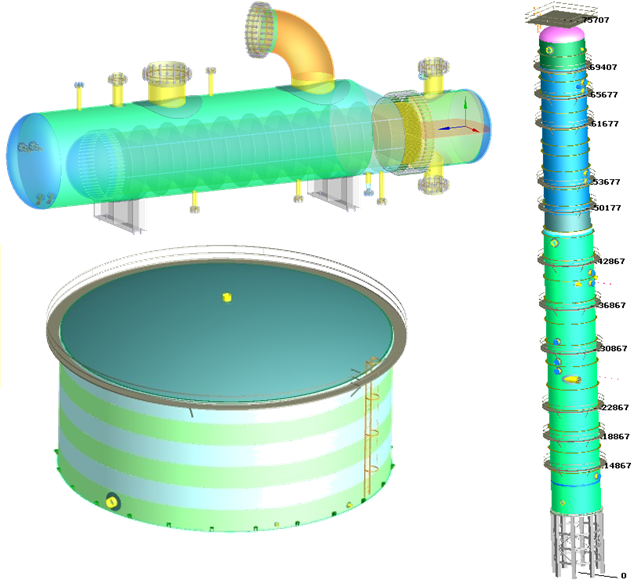
PASS/EQUIP software provides pressure vessel strength and stability analysis for horizontal and vertical vessels, columns, storage tanks, as well as shell-and-tube, and air cooled heat exchangers under static and seismic loads in order to evaluate bearing strength in operation, test, and assembly states. The software can be used for designing, revamping and testing of vessels, as well as for code compliance certification calculations for power, oil-refining, chemical, petrochemical, natural gas, petroleum, and other related industries. PASS/EQUIP helps to increase reliability and operational safety of equipment for various applications, to improve coordination of the project with regulatory authorities, and to reduce costs and time.
PASS/START-PROF is successfully used in many industries:
- Power and District Heating il and Gas
- Process Chemistry Metallurgy Other Industries
Reduces Analysis Time, Effort, and Cost
Features and Advantages
Broad Applicability Databases User Interface
Configurations
UNIT IV
Four Exmples from Text Book will be given trainingOn software listed For the program Four problem will be given for self training with software to Trainee
Configurations
PASS/EQUIP can be delivered in different configurations:
PASS/EQUIP can be also delivered as a bundle with PASS/Nozzle-FEM:
Download Software Resources Additional PASS/EQUIP Resources
PASS/EQUIP. User manual
CODES
UNIT II
Four Exmples from Text Book will be given trainingOn software listed For the program Four problem will be given for self training with software to Trainee
Calculation codes
- API 650-2020. Welded Tanks for Oil Storage.
- ASME VIII, Div 1. Rules for construction of pressure vessels.
- ASME VIII, Div 2. Rules for construction of pressure vessels. Alternative rules.
- EN 13445-3. European Standard. Unfired pressure vessels – Part 3. Issue 1 (2002-05).
- WRC-537 (107) Welding Research Council. Bulletin. “Precision Equations and Enhanced diagrams for Local Stresses in Spherical and Cylindrical Shells due to External Loadings for implementation of WRC Bulletin 107. 2013.
- WRC-297 Welding Research Council. Bulletin. “Local Stresses in Cylindrical Shells due to External Loadings on Nozzles – Supplement to WRC Bulletin №107”. 1987.
- WRC-368 Welding Research Council. Bulletin. “Stresses in Intersecting Cylinders subjected to Pressure”. 1991.
- Bildy, Les M., 2000, “A Proposed Method for Finding Stress and Allowable Pressure in Cylinders with Radial Nozzles,” PVP Vol. 399, ASME, New York, NY, pp. 77-82.
- Zick, L.P., “Stresses in Large Horizontal Cylindrical Pressure Vessels on Two Saddle Supports”, Welding Research Journal Supplement, September, 1951.
- Henry H.Bednar, Pressure Vessel Design Handbook. Second edition. 1986.
- Dennis R.Moss, Pressure Vessel Design Manual. 1987.
- AzDTN 2.3-1. Seysmik rayonlarda tikinti (zərbaycan Respublikası Dövlət Şəhərsalma və Arxitektura Komitəsi).
- IS 1893. Indian Standard. Criteria for earthquake resistant design of structures.
- GOST 34233 (1-12) - 2017. Vessels and equipment. Norms and methods of strength calculation.
- GOST 34283-2017. Vessels and equipment. Vessels and Equipment. Norms and methods of strength calculation from wind loads, seismic influence and other external loads.
- GOST 14249-89. Vessels and apparatuses. Norms and methods of strength calculation.
- GOST 25221-82. Vessels and equipment. Spherical heads and covers without knuckle. Norms and methods of strength calculation.
- GOST 26202-84. Vessels and equipment. Norms and methods of calculation for strength of shells and heads against support loads.
- GOST 24755-89. Vessels and equipment. Norms and methods of strength calculation of holes reinforcement.
- RD 26-15-88. Vessels and equipment. Norms and methods of strength and leak integrity calculation of flange joints.
- RD RTM 26-01-96- 83. Flat round heads and heads with radial reinforcing ribs of vessels and equipment.
- RD 10-249-98 Norms of strength calculation of stationary boilers and steam and hot-water pipelines.
- RD RTM 26-01-44-78. Details of pipelines for pressure over 10 to 100 MPa. Norms and methods of strength calculation.
- PNAE G-7-002-86. Strength calculation norms of the equipment and pipelines of atomic power plants.
- OST 26-01-64-83. Fasteners. Construction and dimensions.
Databases
In order not to enter the necessary settings manually, there are a number of embedded databases:
INTEGRATION
Additional
Four Exmples from Text Book will be given trainingOn software listed For the program Four problem will be given for self training with software to Trainee
Passat Equipment
UNIT III
Four Exmples from Text Book will be given trainingOn software listed For the program Four problem will be given for self training with software to Trainee
Powerful capabilities
PASS/EQUIP provides comprehensive structural pressure vessels analysis.
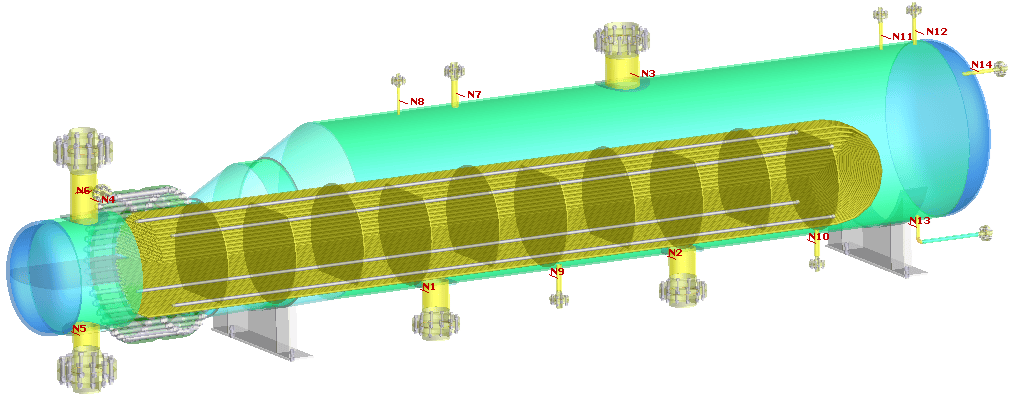
PASS/EQUIP performs strength and stability calculation of horizontal, vertical, and column vessels, and takes into account wind and seismic loads. PASS/EQUIP also calculates strength and stability of shell and tube heat exchangers, including tubesheets, tubes, pass partitions, shells, expansion bellows, expansion boxes, and floating heads. The smart tube grid editor of heat exchanger provides very powerful capabilities of non-standard tubesheets modeling.
User Interface
PASS/EQUIP has a modern, clear and intuitive user interface. Designer uses 3D object-oriented analysis model of equipment assembled from different elements. The objects that make up the equipment 3D model are:
- Cylindrical shells (smooth and reinforced with stiffening rings);
- Conical transitions;
- Welded bottoms and detachable bottoms and covers (spherical, elliptical, torispherical, conical, flat (including with stiffeners), spherical non-flanged);
- Flange connections;
- Places of connections of fittings;
- Saddle supports and cylindrical shells in the places of their support in the case of horizontal vessels and apparatus;
- Cylindrical shells, conical elements and convex bottoms at the points of attachment of the bearing lugs, lifting trunnions, at the points of attachment of metal structures;
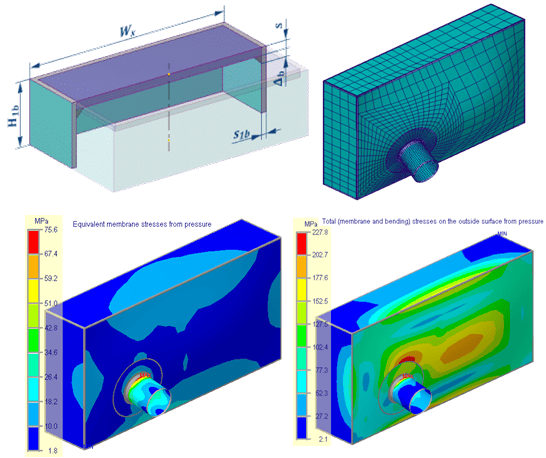
- Reinforcement of holes;
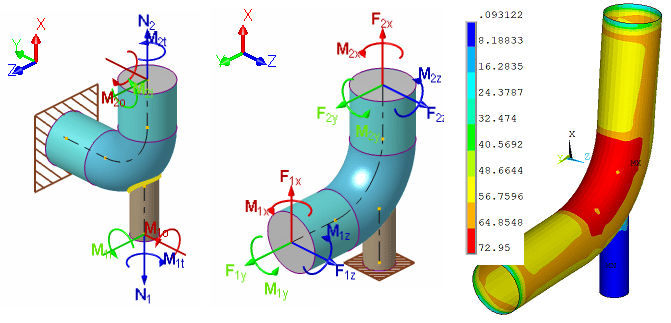
- Bends;
- Tie-in (choke) in shells and convex bottoms;
- Elliptical partitions;
- Ellipsoidal transitions;
- Elements of column-type apparatus against wind and seismic effects, including those installed on a pedestal;
- Supporting shells of column-type apparatus;
- Tube sheets, casing, pipes, compensator, expander, floating head of heat exchangers;
- Chambers of heat exchangers for air cooling;
- Elements of vessels and apparatus with jackets (cylindrical, U-shaped, partially covered by jackets, with coil and register channels, with longitudinal channels);
- Elements of vessels and high-pressure apparatus (shells, bottoms, flanges, covers, tie-ins);
- Elements of vertical tanks;
- Viewing windows, bosses.
START-Elements allows the user to do the following:
- Analyze stress of L, Z and U-shaped piping loops (buried and above-ground)
- Pipe and fitting wall thickness calculation or maximum pressure allowed according to the code selected
- Calculate maximum allowable distances between supports via strength and stiffness analysis
- Check general and local stability of straight and curved pipe elements under the thermal expansion, external pressure (vacuum) and soil pressure loads
- Calculate minimum pipeline laying depth for underground pipeline stability analysis
- Calculate maximum pipeline laying depth for buried pipeline by polyurethane insulation stress analysis
- Calculate allowable load on saddle support for large-diameter pipes
- Calculate allowable distances between single action (one time) compensators and their closing temperature
- Calculate bellows stiffness if the manufacturer’s data are absent
- Flange leak check
- Centrifugal pump load check per API 610 (ISO 13709), GOST 32601-2013 and Kellogg method (L.C. Peng Pipe stress engineering)
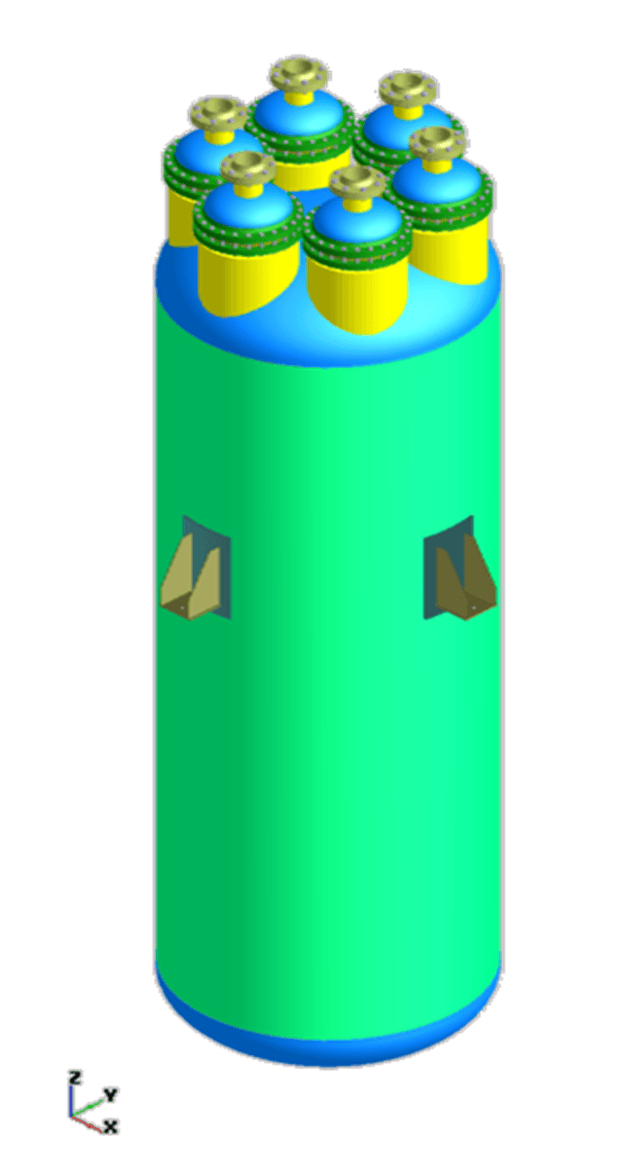
Chemistry Application product selection Guide