Industry Projects
Mechanical Projects NPP Equipment
Internship Program-Project Program-Product Dev, Program


UNIT I
Four Exmples from Text Book will be given trainingOn software listed For the program Four problem will be given for self training with software to Trainee
The calculation of the heat exchanger was carried out by order of SU NPP.
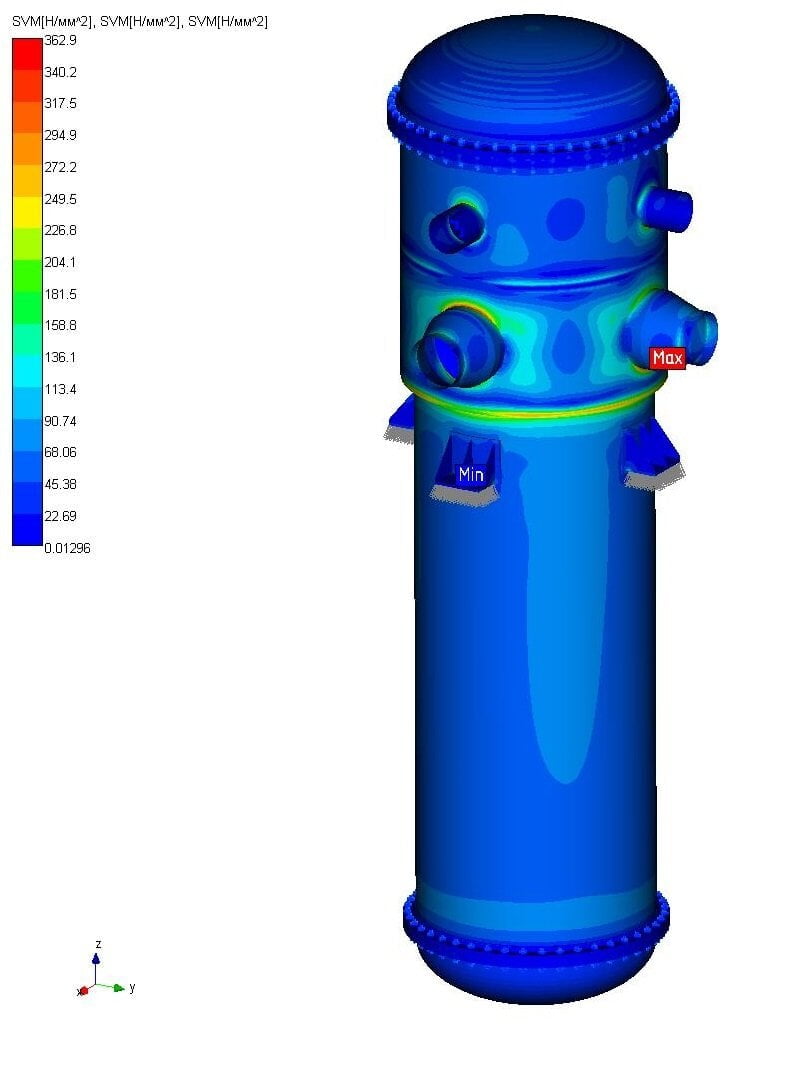
The heat exchanger of the cooling circuit of the spent fuel pool of the NPP is designed to cool the distillate of the spent fuel pool circuit with process water.
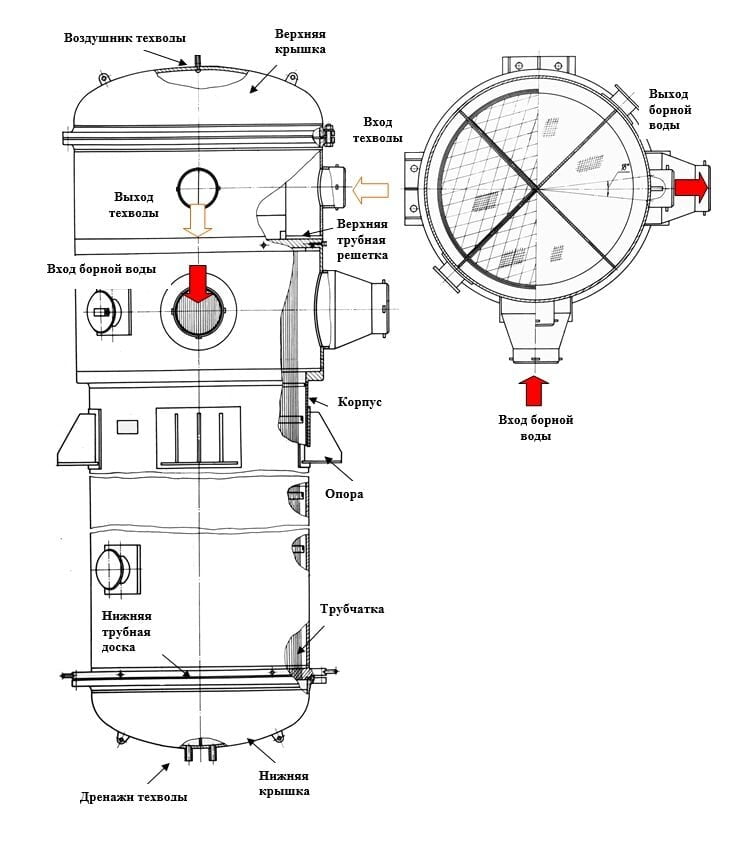
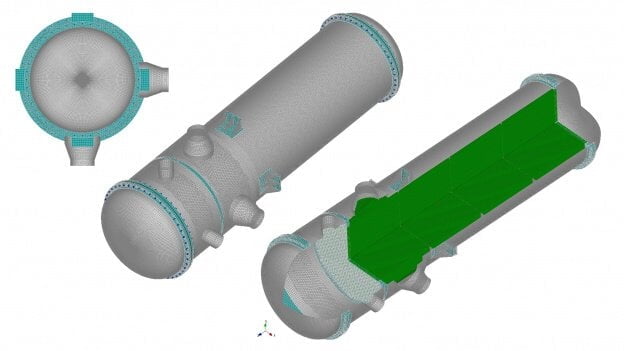
The heat exchanger is a vertical, single-casing, rigid-tube apparatus of the shell-and-tube type, four-pass in the tube and annular spaces with counter-current movement of media. "Hot" distillate moves in the annular space, process water in pipes.
The heat exchange surface consists of tubes arranged in an equilateral triangle, fixed in tube sheets by rolling and welding. The position of the pipes in the body is fixed by spacer grids, which are connected to each other by beacon tubes.
The body of the heat exchanger is made of shells welded together using an adapter.
To organize four passages through the annular space, longitudinal partitions are installed in the body.
Process water is supplied and discharged by pipes into a cylindrical chamber with an elliptical bottom. The chamber is divided by partitions into three cavities to organize four passages through the pipe space.
The calculation was carried out in the APM WinMachine software product.
UNIT IV
Four Exmples from Text Book will be given trainingOn software listed For the program Four problem will be given for self training with software to Trainee
Analyzing the presented results for all calculated model load cases, th
Calculation results
Calculations performed:
- calculation of static strength in the operating state and in the hydrotest mode with the output of stresses by groups of stress categories;
- analysis of cyclic strength of heat exchanger elements for extended service life of 30 years inclusive;
- assessment of the lateral stability of heat exchanger tubes under the action of design pressure in the annular space;
- calculation for resistance to brittle fracture of the flange disc;
- calculation for vibration resistance of structural elements;
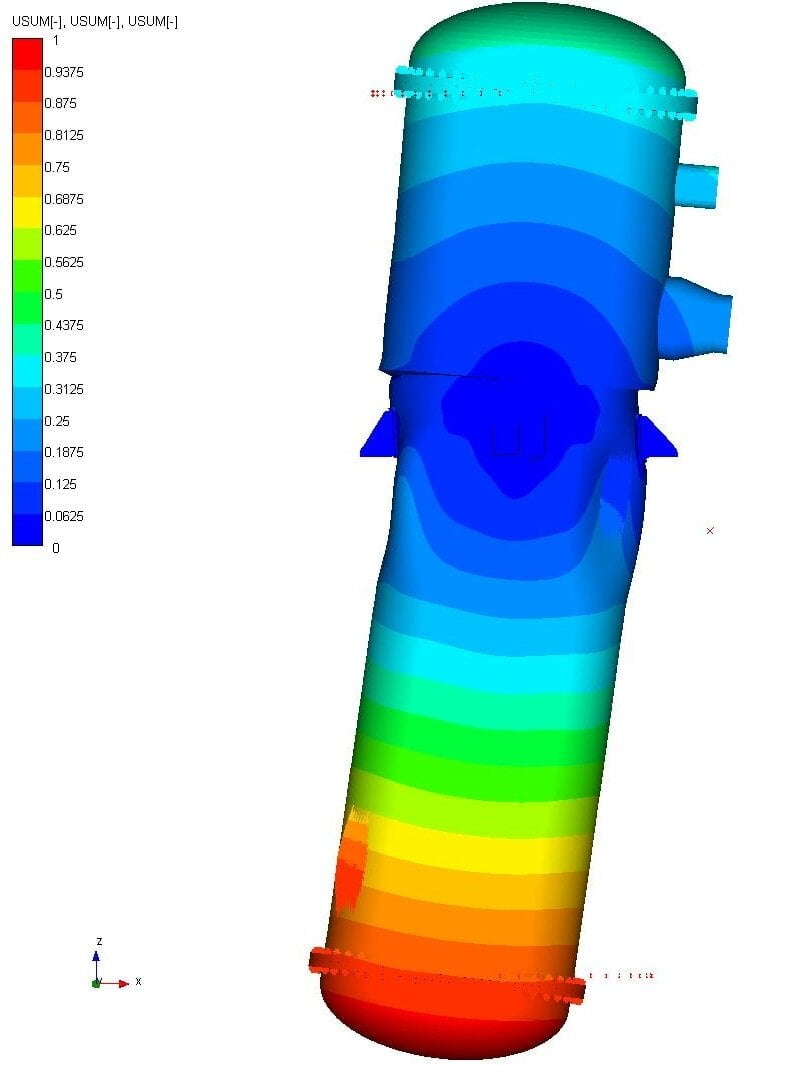
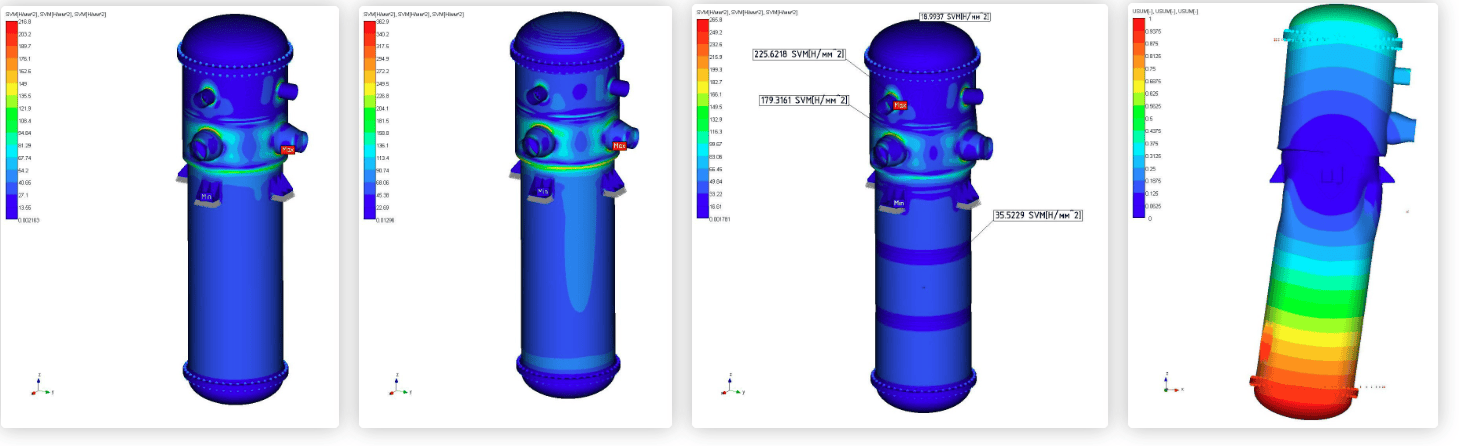
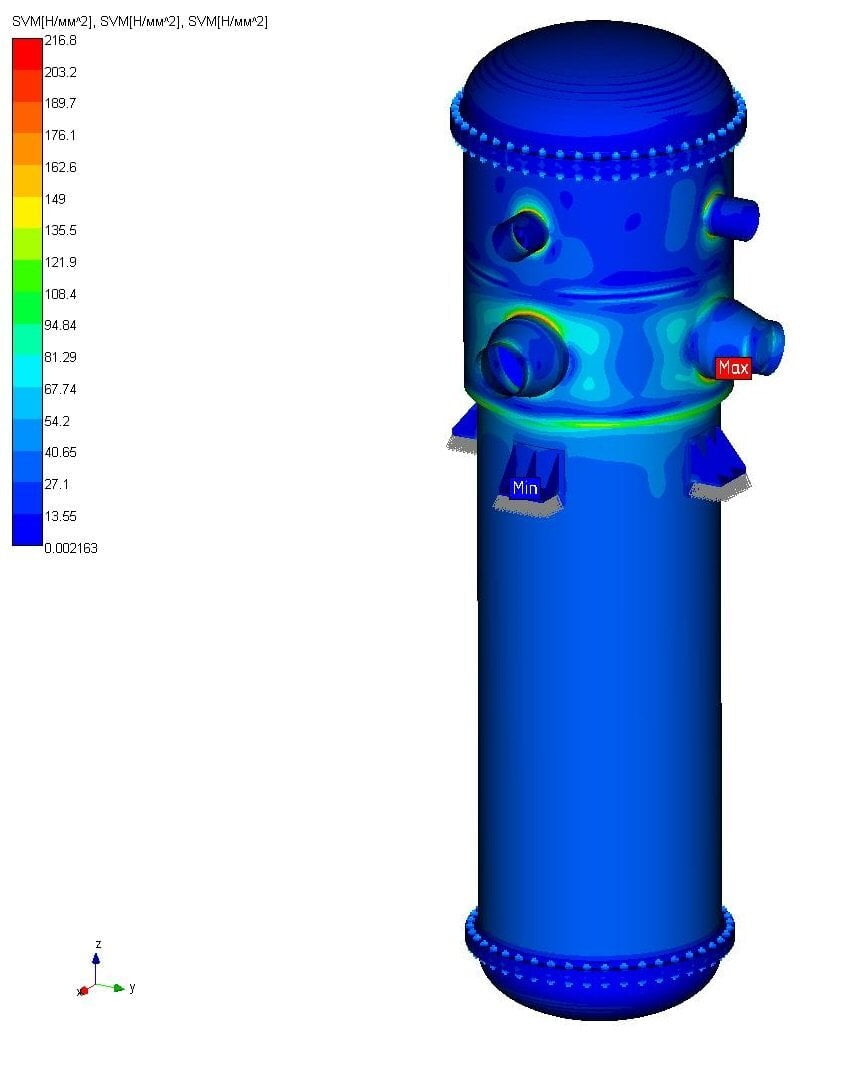
The maximum equivalent stresses in the static calculation, estimated by the Guber-Mises strength hypothesis (strength theory 4), occur in the nozzles at a working medium temperature of 80 0C.Comparing the maximum effective stresses with the permissible yield strength, it can be assumed that the structural strength condition is fulfilled with a yield safety factor equal to 1.8.Seismic action does not make a significant contribution to the overall picture of the stress-strain state of the crane, since the level of stresses from the action of the seismic load both along the axis of the nozzles and perpendicular to the axis of the nozzles does not exceed 1 MPa.The maximum equivalent stresses in the seismic action analysis occur along the axis of the nozzles.The strength of the threaded connection is made with an endurance factor of 6.5 and a margin of safety of 7.8.
The work carried out showed the applicability of APM software complexes for solving complex problems of strength analysis of various structures in the oil and gas industry.
UNIT II
Four Exmples from Text Book will be given trainingOn software listed For the program Four problem will be given for self training with software to Trainee
The NPP heat exchanger is designed for strength, taking into account the extension of the service life of 30 years inclusive.
The strength analysis of the heat exchanger is carried out in accordance with the requirements of:
PNAE G-7-002-86. Standards for calculating the strength of equipment and pipelines of nuclear power plants.NP-068-05. Pipeline valves for nuclear power plants. General technical requirements.RD EO 0330-01. Guidelines for Strength Analysis of Equipment and Pipelines of RBMK and VVER Reactor Plants at the Operation Stage.
In accordance with PNAE G-7-002-86, the following types of calculations had to be performed when analyzing the heat exchanger:
Static strength calculation;calculation for cyclic strength;calculation for resistance to brittle fracture;seismic analysis;Vibration strength calculation.
UNIT III
Four Exmples from Text Book will be given trainingOn software listed For the program Four problem will be given for self training with software to Trainee
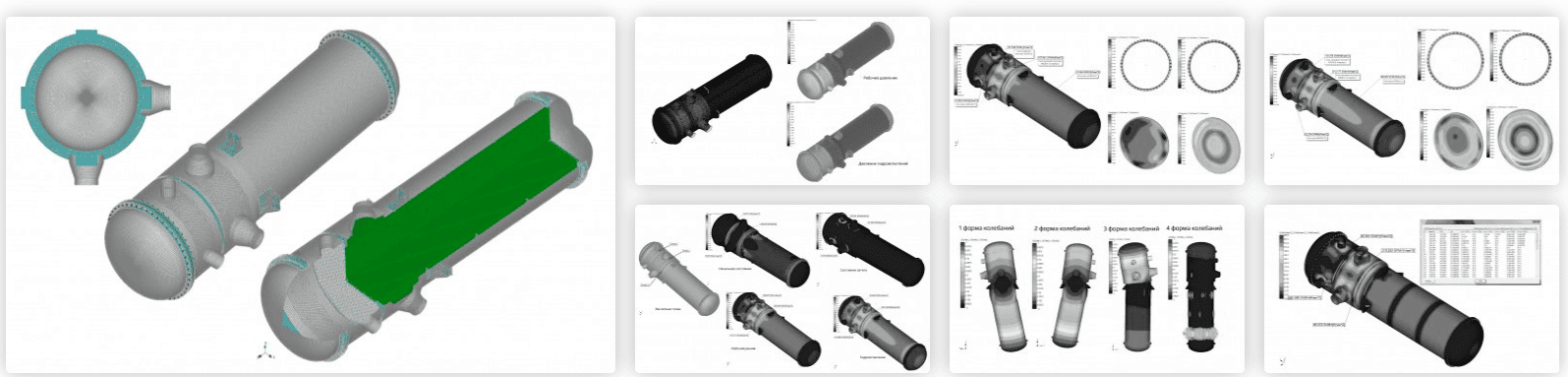
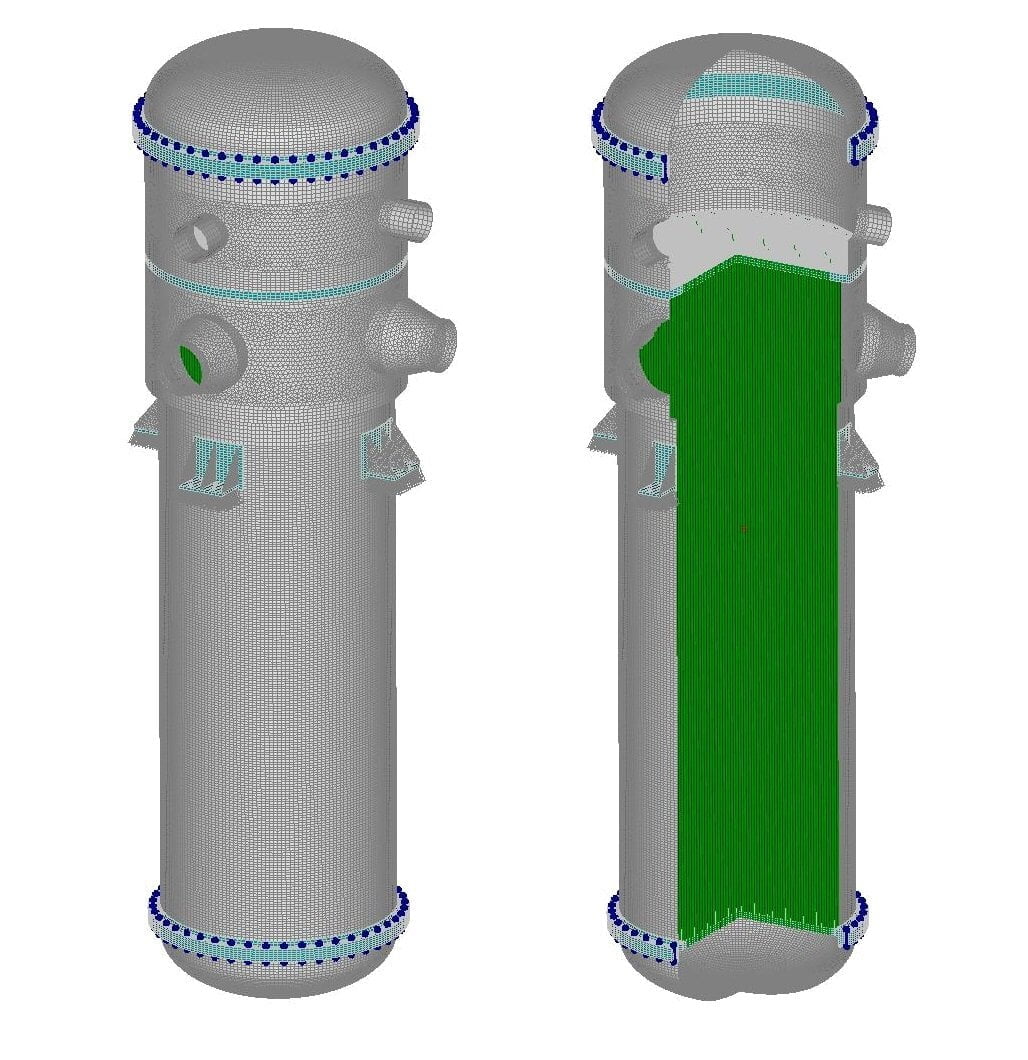
The calculation of the heat exchanger was carried out using the module for calculating the stress-strain state, stability, natural and forced oscillations of parts and structures using the finite element method - APM Structure3D, which is part of the APM WinMachine computer-aided design system for mechanical structures and equipment in mechanical engineering and construction. This module allows you to create analysis models that describe the geometry of the calculated nodes quite closely.
The design model includes all the main elements of the heat exchanger.
When building the design model in the module, the final element "shell" was used for hull shells, fittings, elliptical bottoms.
Heat exchange tubes and flange bolts were modeled using rod finite elements.
Flanges, tube sheets and supports were modeled using volumetric finite elements.
Kinematic boundary conditions were set in the form of a ban on all movements and turns in the places of support of the structure. This fixing allows you to constrain the movement of the model as a rigid body in all directions.
Force boundary conditions were set in the form of:
the heat exchanger's own weight;distributed load on the inner surface of the heat exchanger equal to the value of the pressure acting on each element;loads from the connected pipelines (force and torque);Tightening forces of the flange connection.
The strength of the heat exchanger of the cooling circuit of the spent fuel pool of nuclear power plants for an extended service life of 30 years inclusive is substantiated.
The calculation showed that all elements of the heat exchanger, taking into account the extended service life, meet all the necessary requirements.