Nozzle Analysis
This is a list of the primary theories in physics, major subtopics, and concepts
Women Graduates are trained with basics in Industry application from basic science Mathematics, Physics, Chemistry
Training in application Software by Industry Professional, to train others with preparation as TRAINER to empower.
Empowering areas are ACADEMIC SERVICE-ENTREPRENEURSHIP-DESIGN SERVICE-INDUSTRIES-SOCIAL ENGINEERING
Overview

UNIT I
Four Exmples from Text Book will be given trainingOn software listed For the program Four problem will be given for self training with software to Trainee
Overview
PASS/Nozzle-FEM is designed for stresses and flexibility calculation of nozzle-to-shell junctions using the Finite Element Method (FEM). The program also calculates nozzle’s allowable loads and estimates strength of the nozzle’s junctions for wide range of geometric configurations and operating conditions. Nozzle-FEM helps to provide higher level of the equipment safety along with reducing labour costs at the design stage. The program is recommended for designing and industrial safety review of oil and gas, refining, petrochemical, chemical, power and other industrial facilities.
Powerful capabilities
Allowable stresses calculation according to the rule codes (ASME, EN, JB, GOST etc)
Stress analysis of nozzle-to-shell junction from the action of external loads, pressure and thermal expansion
Creating detail report with calculation results and strength conclusions (HTML, RTF)
Fatigue assessment according to ASME VIII.2 and GOST
Allowable loads for nozzle\support and unconstrained shell ends
Stress intensification factors (SIF) calculation
Reduces Analysis Time, Effort, and Cost
Features and Advantages
Broad Applicability Databases User Interface
Configurations
UNIT IV
Four Exmples from Text Book will be given trainingOn software listed For the program Four problem will be given for self training with software to Trainee
Configurations
PASS/NOZZLE-FEM can be delivered in different configurations:
PASS/NOZZLE-FEM
PASS/NOZZLE-FEM provides FEM analysis for nozzle and vessel connections.
PASS/EQUIP FEM Complete
PASS/EQUIP FEM Complete is a bundle that provides comprehensive design by rules and design by FEM analysis. Includes Vessel, Column, Exchanger, Tank & Nozzle analysis.
Download Software ResourcesVideos Supporting Materials Additional PASS/NOZZLE-FEM Resources
CODES
UNIT II
Four Exmples from Text Book will be given trainingOn software listed For the program Four problem will be given for self training with software to Trainee
Allowable stresses for finite element method (FEM) analysis are defined by the following codes implemented in Nozzle-FEM:
- ASME Boiler and Pressure Vessel Code. Part D. Properties. Section II, Materials - 2019.
- ASME Boiler and Pressure Vessel Code. Rules for Construction of Pressure Vessels. Section VIII, Division 1 – 2019.
- ASME Boiler and Pressure Vessel Code. Rules for Construction of Pressure Vessels. Section VIII, Division 2 – 2019.
- EN 13445-3. European Standard. Unfired pressure vessels – Part 3. Issue 1 (2002-05).
- JB 4732-1995-EN. Professional Standard of the People's Republic of China – 1995.
- GOST 34233.1-2017. Vessels and apparatuses. Standards and methods of strength calculation. General requirements.
- GOST 34233.6-2017. Vessels and apparatuses. Standards and methods of strength calculation. Strength calculation under low-cyclic loads.
- GOST 34233.10-2017. Vessels and apparatuses. Standards and methods of strength calculation. Vessels and apparatuses operating in hydrogen sulphide environments.
- PNAE G-7-002-86. Standards of strength calculation for equipment and pipelines of nuclear power plants. –M.: Energoatomizdat, 1989
Besides finite element method calculation, the program supports CIF and flexibility calculation via semi-analytic methods according to WRC 537/107(297) (Welding Research Council Bulletins No. 107, No. 297 "Local stresses in spherical and cylindrical casings caused by the external loads") and BS5500-76 (British standard).
PASS/Nozzle-FEM performs similar calculations (without FEM analysis) of vessel elements and nozzle junctions as per the following codes:
- WRC-537 Welding Research Council. Bulletin. "Precision Equations and Enhanced diagrams for Local Stresses in Spherical and Cylindrical Shells due to External Loadings for implementation of WRC Bulletin 107". 2013.
- GOST 34233.2-2017. Vessels and apparatuses. Standards and methods of strength calculation. Calculation of cylindrical and conical shells, dished and flat bottoms and covers.
- GOST 34233.3-2017. Vessels and apparatuses. Standards and methods of strength calculation. Reinforcement of openings in shells and heads under internal and external pressure. Strength calculation of shells and heads under external static loads on the nozzle.
INTEGRATION
Additional
Four Exmples from Text Book will be given trainingOn software listed For the program Four problem will be given for self training with software to Trainee
Integration
PASS/Nozzle-FEM model can be created and transferred from PASS/EQUIP software.
The special variant of PASS/Nozzle-FEM has been developed for tie-ins (tees and fittings) and shell-to-nozzle junction calculation as per WRC and GOST, to be called directly from PASS/START-PROF software. Any Nozzle-FEM results can also be user in the piping system analysis by PASS/START-PROF in manual mode.
Nozzle FEM
UNIT III
Four Examples from Text Book will be given trainingOn software listed For the program Four problem will be given for self training with software to Trainee
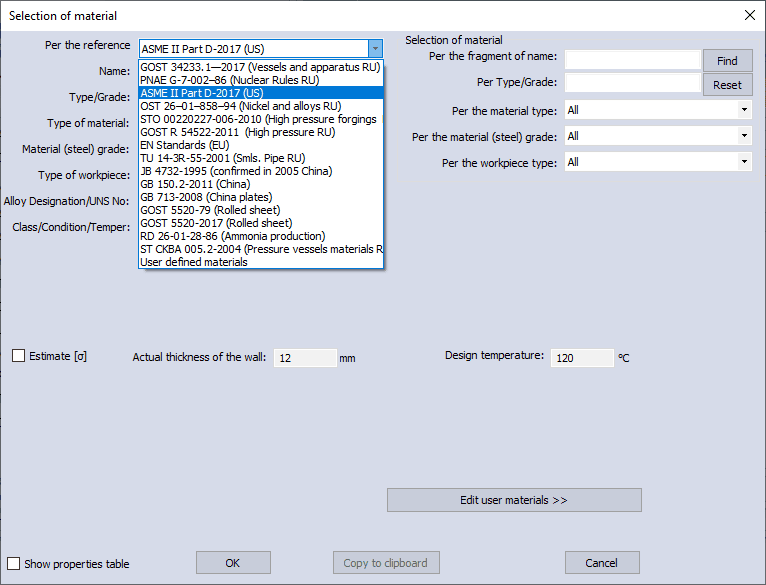
Materials database
The material database includes physical and mechanical properties of vessel elements materials according US, European, Chinese and Russian codes.
User Interface
The program has a modern, convenient, easy and friendly graphical user interface (GUI), which includes interactive user tips and user manuals in English and Russian languages.
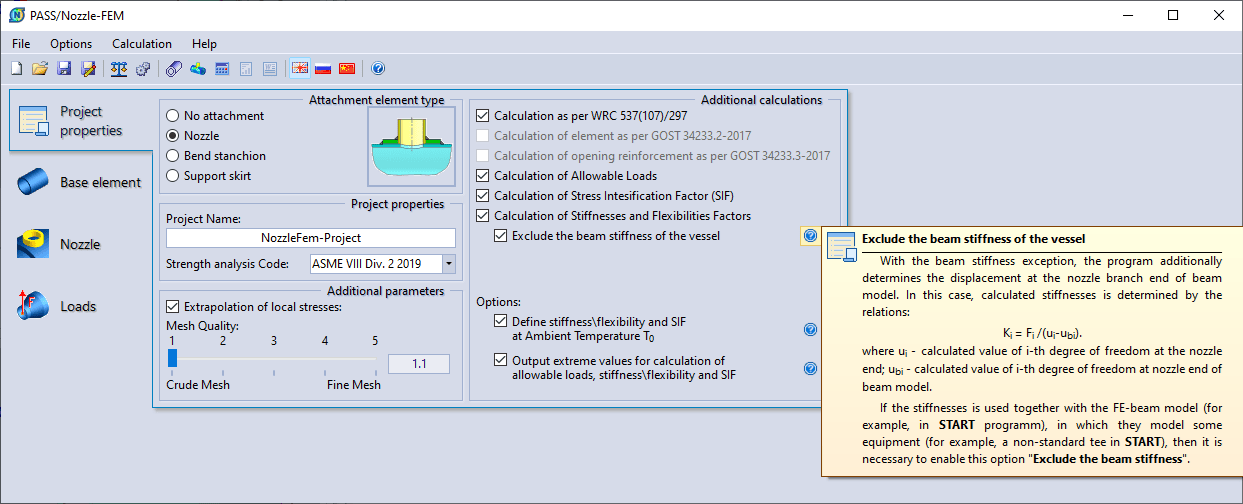
PASS/Nozzle-FEM allows to create a several base design scheme by attachment element type:
PASS/Nozzle-FEM allows to model a variety shell elements, which greatly simplifies the design model creation:
Chemistry Application product selection Guide